Feedback request: 4-hour cycles in upcoming proposal

Following the successful activation of Seoul, protocol developers at Nomadic Labs, Trilitech, and Functori are preparing our next Tezos protocol proposal.

A key change is reducing the cycle length from 1 day to 4 hours, together with changes to parameters relating to baker and staker operations, consensus security, and overall user experience.

These changes offer meaningful improvements for users of Tezos, but can also impact bakers’ business logic and tools. Before moving development into the stabilization phase, we would like to gather your feedback.

Changes relating to 4-hour cycles

The changes are the following:

  • Cycle length: 1 day → 4 hours

    • Baking rights recalculated every 4 hours

    • Attestation rewards are distributed to bakers and stakers every 4 hours (distribution to delegators depends on the baker)

    • New bakers earn rights within 4 hours

  • Tolerance period for inactive bakers:

    • For bakers with >1% stake: Tolerance reduced from 2 days → 4 hours

    • For bakers with ≤1% stake: Tolerance remains 2 days

  • Unstake period: 4 days → 12 hours

The governance process remains unchanged, with each period still being ~14 days. See the table below for a full overview of the impact.

Parameter Seoul Proto T Impact
Cycle length 1 day (10,800 blocks) 4 hours (2,400 blocks) The network reflects changes quicker.
Governance period duration 14 days (14 cycles) 14 days (84 cycles) The duration (in days) of the governance process is the same.
Consensus rights delay 2 days (2 cycles) 4 hours (1 cycle) Quicker update of consensus rights after the staked/delegated balance changes.
Unstake finalization 4 days (4 cycles) 12 hours (3 cycles) Shorter wait for unstaked funds to be finalizable (made liquid).
Staking parameter changes 5 days (5 cycles) 5 days (30 cycles) The duration (in days) of the staking parameters activation is the same.
Consensus key (de)activation 2 days (2 cycles) 4 hours (1 cycle) Quicker activation and deactivation of consensus keys.
Inactivity tolerance for large bakers (more than 1% of total stake 2 days (2 cycles) 4 hours (1 cycle) Shorter inactivity tolerance for large bakers preserves chain liveness in case they go offline
Inactivity tolerance for small bakers (1% or less of total stake) 2 days (2 cycles) 2 days (12 cycles) Baking remains accessible to small bakers with lightweight infrastructure, whose online status has less impact on network liveness

Why these changes?

The rationale for 4-hour cycles is a combination of several factors:

  • Improved network resilience: More frequent rights computations and faster deactivation of inactive large bakers (defined as holding >1% of the stake) improve network security.

  • Smoother baking and staking operations: Bakers and stakers benefit from shorter delays for key updates, rewards, and unstaking.

  • More attractive staking: A shorter unstaking period increases flexibility for stakers, including a better ability to react to market volatility.

We want your feedback

As mentioned, these changes may impact bakers’ operations, business logic, and tools, so your comments are valuable — both to help us refine the proposal where technically possible, and to help tool providers adapt smoothly.

By sharing your questions and insights, you help us ensure we strike the right balance between the benefits of faster cycles and the practical realities of baker operations and tooling. Together, we can shape a stronger proposal for Tezos!

(EDIT: Paragraphs on improved staking attractiveness and distribution of attestation rewards have been adjusted for clarity.)

5 Likes

Do not reduce unstaking time (If anything, increase it)

If we cut unstake time from 4 days to 12 hours, we will not improve Tezos staking. We would erode the very commitment device that converts volatility into conviction and we would be replacing it with the very bank-run dynamics that the unstaking time period is meant to prevent.

1. Purpose of unstake time: retention, not convenience

The unstake window exists to induce longer commitments. Entry is near instant, exit takes time. That asymmetry is deliberate. It is how retention works in behavioral finance. People align their beliefs with what opportunities are available, not with what is optimal for them. This is only supercharged in a fight-or-flight situation.

In times of market volatility and even momentary panic, the 4 day buffer induces participants’ sense to accept that their tez (even if they unstaked it ‘now’) will not be liquid in time. That simple fact changes their mindset. With a long enough unstake time, most do not even consider unstaking it because they know the moment will have passed. That is, it precludes them from even thinking of rationalizing unstaking their tez. Others even rationalize their past choice to stay staked and even scale it, reminding themselves that they were smart to commit.

If we collapse that buffer to half a day, we not only mitigate the effect, but we actually reverse the effect. In moments of panic, people scan their portfolios and ask what they can liquidate first. Their minds do not go to the weakest asset objectively, they go to the asset that is nearest to liquid. By competing on shortest unstake, we induce people to treat Tezos as the weak link in their portfolio, not because it truly is, but because it is the easiest to exit. In that way, short unstake times manufacture fragility and create an induced sense of no confidence at the very moment when confidence matters most.

2. Misuse of Incentives

The argument for shorter exits is that it might encourage more staking. That misunderstands how incentives work and their role in these ecosystems. The reward is the incentive, and incentives are meant to override friction.

The value advantage is frontloaded. People everywhere in finance accept lockups, from bonds to CDs, because the return justifies the friction. Other blockchain ecosystems’ lockups range from several days to several weeks. Those blockchain ecosystems are not competing on the ‘shortest unstake time’ for a reason. Reducing unstaking friction does not strengthen sustainable adoption, it weakens it.

(I wrote more about optimising incentives use in the ecosystem, here).

3. Misuse of Feedback Loop

When asked, users will always say they want shorter unstake times. But that feedback is a trap and not a reason to actually reduce it. If you reduce from 4 days to 12 hours, they will still say it is too long, because what they want is instant liquidity. Appeasing that demand is a losing game.

In behavioral finance terms, reducing unstake time would amplify loss aversion and liquidity preference. It would condition participants to keep Tezos in the category of assets they can liquidate first, which undermines its role as a commitment asset.

The right metric is retention, not appeasement. The people who refuse to stake their tez, or more of it, unless the unstake window were reduced are not the people nor the mindset we should be chasing.

By competing on shortest exit times, we do not increase confidence. We manufacture no confidence, because we teach participants that Tezos is the nearest-to-liquid asset and therefore the one to liquidate first in a downturn.

What the individuals giving this feedback are really saying is: you are not making it easy enough for me to exit this system and sell. In other words, I like getting rewards for free, but I also want the ability to dump as quickly as possible, and you’re not making that easy. It is not wise to ask them what they want, because they will tell you things that, if acted upon collectively, create the very conditions of a bank run.

4. Risk of Capital Flight

A reduced, 12 hour window invites capital flight. Liquidity signals weakness before and during market panic. Liquidity and confidence become inversely linked. Traders and automated systems will identify Tezos as the fastest stake to unlock and will front run exits. That anticipation itself triggers cascades.

The danger does not stop there. Once traders and bots recognize this pattern, it becomes part of their standing strategy. The rule becomes automatic: unstake and sell Tezos first. That makes every market downturn disproportionately steeper for XTZ than it needs to be, because the exit is no longer a decision, it is pre-programmed behavior.

Capital flight also damages perception. Markets would remember which assets bled out fastest. If Tezos develops a reputation as the chain where liquidity always runs first, that stigma persists long after the panic ends. It becomes part of how investors categorize Tezos in their mental map of risk. If there’s any whiff that the market might stumble short term, the precaution will be to unstake and sell XTZ (just in case).

There are operational consequences too. Frequent unstake churn undermines baker stability. Staking positions rotate in and out more often, which erodes predictability of rewards and makes it harder for bakers to plan. That weakens the operator base at the very moment when the network needs it strongest.

Finally, capital flight at the staking layer spills over into DeFi. Large amounts of tez unstaked quickly are more likely to be dumped into liquidity pools or exchanges, destabilizing pairs and creating slippage. What starts as a staking design choice cascades into price volatility, DeFi fragility, and reputational damage all at once.

5. Attribution

The real adoption barrier is not unstake time but marketing. Most tez holders still do not know that staking exists or how it works compared to delegation. It’s hard to remedy, and will take more time and iteration, but if we try to compensate for missing awareness with protocol changes, we would undermine the very commitment mechanism that staking relies on, while undermining the work that actually matters.

If we shorten the unstake window, we additionally lose the ability to measure whether it made any difference. Any increase in staking afterward would be impossible to attribute clearly, because many other factors could be driving it. We would lock ourselves into a fragile design without ever proving it was the cause.

6. Calibration vs Drastic Reductions

If 4 days is for any reason too long, we should not reduce it by 87% all of a sudden. That is bad science. It is bad testing. It is bad practice. Finding the right time should be done in small steps, not in a single cliff cut. Reduce gradually and measure real effects: staking churn, the link between drawdowns and unstake volume, how quickly people restake aftershocks, and what share of exits actually leave the chain. A cliff cut skips learning and gives us no usable signal.

7. Suggestion: Increase Unstaking Time to 42 cycles (i.e. exactly 7 days; 1 week)

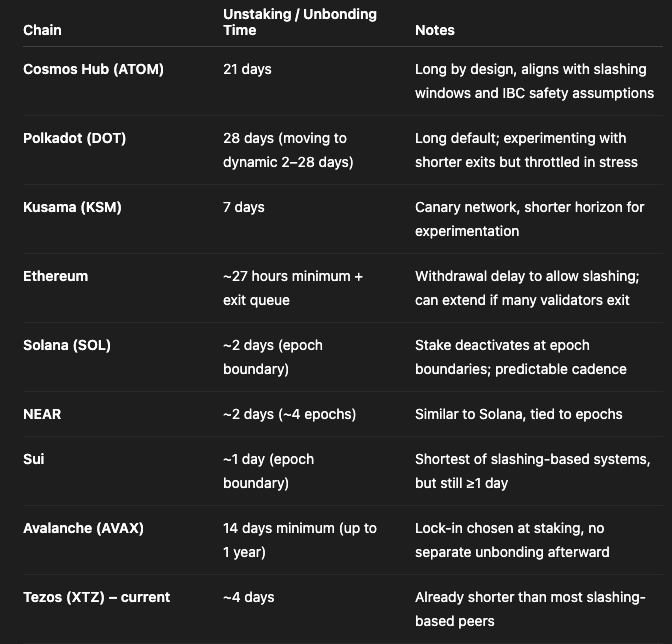
By the same logic, I would go so far as to suggest that we increase unstaking time. Looking at the comparison chart across bonded-stake blockchains, the lesson is clear: among networks that actually secure consensus through bonded staking, multi-day unstake windows are the norm. Tezos should not compete to be the fastest exit. If anything, we should lean slightly longer.

A 7 day window, or 42 cycles under a 4 hour cycle length, is a healthier balance. It places Tezos in line with the norms of other serious bonded proof-of-stake networks, rather than leaving it exposed as the outlier that drains first. A weekly window also gives participants the time they need for news to resolve, prices to mean revert, and emotions to cool before taking action. This is the buffer that breaks the reflex to liquidate whatever is nearest to liquid.

It also benefits bakers. Staking inflows and outflows become smoother and more predictable on a weekly rhythm, which strengthens the operator base and makes rewards steadier. At the same time, 7 days is not excessive: it is long enough to matter, but short enough to fit normal portfolio management cycles.

Rights, payouts, and inactivity pruning can still be accelerated independently. Those should be decoupled from the exit window. The unstake period should remain deliberately long, with 7 days as the more resilient and more natural setting.

The Tezos staking economy gains strength from commitment, not convenience. We should extend that strength, and project confidence, not hollow it out to simply to possibly appease the exact opposite of the market cohort that we should be targeting.
6 Likes

I agree with Kevin. If unstaking becomes almost instant. where is the point in staking. How does it raise security. How can there be enough time for refutation in case of bad acting?
Also, a 4-hour cycle puts a lot more pressure on bakers to payout delegators. For many users, rewards will be so tiny that they are consumed by transaction costs. That is already now the case with 1-day cycles. We will need tools to batch payout multiple cycles.
In general I don’t really understand the necessity of shorter cycles.

2 Likes

We over at Tez Capital expect to have TezPay ready for aggregated payments in November. While we do have the feature coming, it’s worth mentioning that we will also need TzKT to be able to recognize these payments to minimize delegator confusion. Currently everything is very much driven per-cycle.

Speaking of TzKT and Baking Bad, I wonder how this change would affect them in other ways and whether they have enough time to respond.

3 Likes

+1 here.

The last 2 arguments are very questionable.

  • The first point makes sense, if we find a way to get this one without affecting the unstaking period the same way we dont affect the Governance period, I dont see any problem. Bringing back big bakers in case of emergency is a sensible idea.
  • Changing Keys? Not very often and some will never do it, so 4 days is acceptable. Faster Unstaking? = Kevin Post.
  • The last point is very Questionable… Apart from being a Baker I’m a user first… Staking is a Economic Commitment, Bakers and Stakers receive Rewards for a reason, again, Game Theory here + Kevin post explains why this is not about being flexible. They had Delegation and didnt use it, never cared, wihout any Economic Commitment, they didnt care either. WHO are we offering this flexibility to? Am I missing something?

My Stakers are pretty happy with the last changes, nobody ever complained or I have not seen anybody in the space asking for shorter Cycles, they have Delegation for that with its respective Rewards according to their economic commitment which I would say it is ZERO, so, if it were for me I would get rid of Delegation, even more now that we have Native Multisig available.

Thanks for bringing the key points in advance for discussion, nice addition to the Proposals flow.

2 Likes

If someone needs instant liquidity they would just hold a staking derivative. I would argue that as long as security isn’t impacted lowering the risk would make the use in defi more attractive vs Tez being relegated to a gas token while also making staking with independent bakers more attractive.

The closing commitment argument also just feels cult-like and off putting. The alternative to convenience is not going to be loyalty and sacrifice. Not when it’s explicitly admitted to being that arbitrary and just something to be demanded by decree. I assumed the unstake period was 7 days, or even aligned with L2 withdrawals, there may be reasons to go in that direction instead, but using that as a goal to justify economic design is seriously concerning.

1 Like

Hello everyone,

Thank you very much for your feedback — we have received it.
It’s highly valuable and covers a broad range of topics, so we’ll be coordinating across teams to address it properly.

You can expect a response from us tomorrow. In the meantime, please feel free to share any additional comments you may have.

2 Likes

From indexers perspective making cycles 6x shorter is a quite unwanted change, because it will make DB grow up to 6x faster, because in Tezos there are a lot of cycle-based data (like payout transactions, stakes snapshots, voting snapshots, baking rights, etc.) and more cycles means more data. So, this change will eventually cause higher infra and maintenance costs for indexers and explorers.

Speaking about mentioned rationales,

Improved network resilience: More frequent rights computations and faster deactivation of inactive large bakers (defined as holding >1% of the stake) improve network security.

This one can be achieved by measuring the tolerance period in blocks, instead of cycles.

Smoother baking and staking operations: Bakers and stakers benefit from shorter delays for key updates, rewards, and unstaking.

Shorter delays are not always better, especially in scope of rewards. Spamming users with too frequent baking and staking events doesn’t seem cool. For example, would you be happier if you had 4-hours-salary, or had to pay bills on a 4-hours basis?

More attractive staking: A shorter unstaking period increases flexibility for stakers, including a better ability to react to market volatility.

Are stakers complaining about the lack of flexibility with 1d cycles? IMO, it already works fine, and everyone is happy. Moreover, a longer lock period is usually more healthy for the ecosystem.

So, frankly speaking, in this change I see more problems than real benefits :slight_smile:

6 Likes

Hello everyone,

Thank you again for the thoughtful and constructive feedback. We recognise that reducing the unstaking period from four days to twelve hours is a major change, and we’re carefully considering its implications. The goal is to make staking more accessible to newcomers and delegators who are cautious about long-term commitments and prefer to remain liquid, even though many already delegate for extended periods and could opt to stake instead.

From a protocol design perspective, the unstaking period combines a consensus delay and a slashing window. With Tenderbake’s two-block finality (~16 seconds) and the two-cycle slashing period (~8 hours with 4-hour cycles), a 12-hour delay still provides a meaningful buffer for network security, while greatly improving flexibility for users. This is also designed to accommodate bakers’ operational needs, including maintenance windows and incident resolution timeframes. That said, we remain open to considering an intermediate step (e.g. 24 hours), if the community feels a more gradual transition would be preferable.

To ensure this change meets its goals, education and communication will be essential. Awareness of staking’s benefits is not yet widespread, and many tez holders continue to delegate. We plan to accompany the rollout with clear educational materials explaining:

  • how staking differs from delegation,

  • how security and slashing guarantees are maintained, and

  • how the shorter unstaking period brings staking closer to delegation in flexibility while preserving its economic role in securing the network.

The objective is not to replace delegation, which remains an important and legitimate option, but to encourage broader participation by making staking more approachable and by helping tez holders choose the mode that best fits their needs.

We also heard concerns about UX complexity, especially around delegation reward distribution. These are being actively addressed:

  • The Octez delegation calculation tool is being updated to provide finer-grained tracking across multiple cycles, with detailed per-cycle logs for better transparency.

  • TezPay, mentioned in previous comments, continues to evolve as a solution for off-chain reward distribution, giving delegators who prefer frequent payouts a simple way to continue receiving them.

These improvements aim to simplify management for both bakers and delegators, and ensure that the ecosystem offers clear, reliable tools regardless of how participants choose to engage.

In summary, our goal is to strike the right balance between security and flexibility. We see value in the liquidity benefits of a shorter unstaking period, but we also hear the desire to preserve the behavioral incentives that long windows create. We’ll continue gathering feedback, refining the approach, and working with the community to ensure any change is well understood, well supported, and accompanied by the right tools and educational efforts.

We warmly welcome your continued input on these points.

2 Likes

This perspective overlooks key aspects of protocol security. While the slashing window is important, security also depends on the ability of operators to respond to adverse on-chain events.

The most critical risk isn’t even an active attack, but a passive concentration of power. Consider a scenario where market conditions cause many smaller bakers and their delegators to exit. As the total amount of active stake on the network rapidly decreases, the relative share held by the largest, most stable pools would automatically inflate. With a short unstaking period, this could push them over the one-third (1/3) network-halting threshold by default, leaving the community with no time to react and restore decentralization.

We should consider why the originators of this consensus family, Cosmos, chose a 21-day unstaking period.

4 Likes

I feel you guys are so bad at actually listening feed back

You always end up doing what ever you see fit without proper arguments to back it up

1 Like

I have yet to meet someone who is avoiding Tezos because the unstake period is 4 days. I’ve also never heard someone make such an argument. Is there really someone with millions of dollars, sitting on the sidelines waiting for a 12 hour unstake period to buy XTZ? I can’t see how the benefits of this change outweigh the costs.

5 Likes

I am Grimoire Weiss, wielder of arcane might and infinite wisdom! And I must warn you mortals…

From personal experience, most players who want to stay liquid at all times, follow one simple doctrine: any altcoin exists to ultimately make more Bitcoin. Whatever makes it easier, is good for them. You can agree or disagree with that, but there is no other path for them. You cannot influence that postulate with anything other than constant rise of the token price against Bitcoin. And even then their goal will stay same, just postponed from “right now“ to “let’s wait to see where it tops“. I can see only one scenario when short unstake delay will be useful - if it really could cause lots of passive/delegation share to stake, leading to issuance cuts. But I have big doubts that “lots“ gonna be the case.

Unless it’s of course accompanied by wb9e on golden unicorn charging into bearwhales jk

I mean, it can be useful. But there must be something more outta there than just “flexibility for users“ and “being more accessible for newcomers who are cautious about long-term commitments“ (4 days isn’t a long-term commitment at all). If there is something more to it, then fine

4 Likes

Instead of continuous slashing, why not just immediately eject the baker out of BFT consensus and have them manually join back in once the problem is settled?

Is there really someone with millions of dollars, sitting on the sidelines waiting for a 12 hour unstake period to buy XTZ?

Maybe there is? This is certainly a factor in investing decisions.

But anyway the unstaking period is here for security, not for economics. If the network remains safe with the unstaking period as proposed, there is no reason for it to be any longer.

2 Likes

For DB growth: hopefully this is more than compensated by the mandatory switch to tz4 endorsements which greatly reduces the size of blocks and number of endorsement operations to index.

2 Likes

For DB growth: hopefully this is more than compensated by [another change]

I think it would be more correct to assess pros/cons ratio for each change separately - this would allow us to maximize the pros/cons ratio for the overall protocol update.

And since I don’t get (with the given explanation) strong pros over cons for cycle shortening, I would prefer to avoid it and eventually benefit from both: slowing down the current growth from attestations AND preventing the unnecessary growth from cycle-based data.

the mandatory switch to tz4

That’s interesting. Right now it’s not mandatory. Are there plans to force bakers on the protocol level to switch to BLS keys?

3 Likes

Agree with you!

If you want to increase the staking percentage, you should first add the option to stake in Ledger

3 Likes

Hello everyone,

Thank you for the valuable feedback shared on this topic. After reviewing the discussions, we have decided to withdraw the proposed reduction of the unstaking period from the upcoming protocol proposal.

Our approach remains guided by the goal of designing a flexible and secure protocol, rather than introducing artificial constraints to counter behaviours for which we lack factual evidence. So far, the only solid observation is that the previous cycle reduction correlates with a higher staking ratio. This is a positive signal for security, though correlation is not causality.

Furthermore, our analysis indicated that a shorter unstaking delay would remain compatible with network security and operational requirements.

As the feature is not urgent, we believe it deserves further discussion and broader consensus. We’ll therefore keep it out of the current proposal and continue the conversation with the community.

Thank you again for your engagement and constructive input.

12 Likes