I am writing this with love.
That matters, because criticism without love turns into sport. It turns into dunking. It turns into the cheap pleasure of sounding right while something you care about keeps drifting.
I do not want to dunk on Tezos.
I have given years of my life to this ecosystem. I have sat with bakers at every level of sophistication. I have helped people through upgrades, key migrations, voting confusion, payout issues, protocol changes, TezSign, TezGov, and the thousand small anxieties that only show up when real people are using real infrastructure with real funds at risk.
I have defended Tezos when it was easy. I have defended Tezos when it was lonely. I have defended Tezos because I still believe there is something here worth defending.
But love also has a duty to tell the truth.
And the truth is this: Tezos no longer owns the frontier of on-chain governance.
We helped define that frontier. We should be proud of that. Tezos gave crypto one of its most serious attempts at self-amendment: a chain that can propose, vote, test, and activate protocol upgrades without hard forks. That mattered. It still matters. The protocol amendment process remains one of the great pieces of blockchain design.
But the rest of the world did not stand still while we admired the elegance of our own machinery.
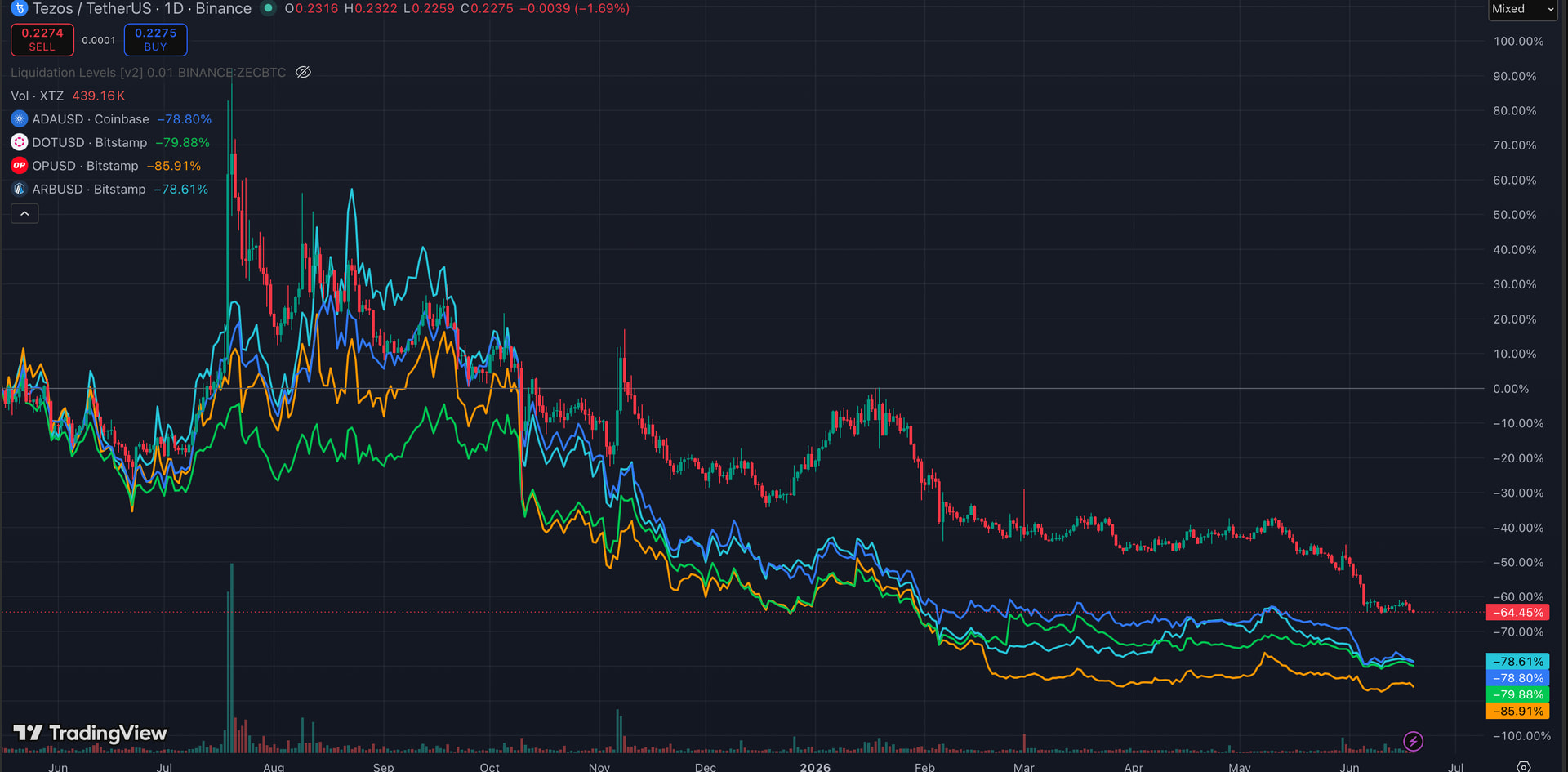
Polkadot now has OpenGov, where all referenda are public, proposals move through specialized origins and tracks, multiple referenda can be active at once, and voters can delegate differently across domains. Their treasury is not just a vague ecosystem promise. It is an on-chain pot funded by fees, inflation, slashing, and other inflows, with treasury proposals, bounties, tips, and spending tracks routed through governance.
Cardano has Project Catalyst. Whatever one thinks of Cardano, and I have many criticisms, they are actively trying to work out decentralized funding in public. Catalyst says it has funded 2,221 proposals, with more than $150M in total funding, more than 11,000 proposals voted on, and millions of votes cast.
Again, this is not me saying Cardano has solved governance. It has not. It is messy. It is political. It is often chaotic.
But there is life in the chaos.
Optimism has built governance around a Token House, a Citizens’ House, public capital allocation, retroactive public goods funding, governance fund proposals, and a revenue model where OP Chains contribute back into a shared treasury.
Arbitrum has a DAO with tokenholder voting, Arbitrum Improvement Proposals, and a built-in treasury smart contract whose funds can be directed by governance.
These systems are imperfect. Some are plutocratic. Some are captured. Some are wildly inefficient. Some will probably create their own ugly politics and backlash.
But they are alive.
People are arguing there. Builders are proposing there. Delegates are building reputations there. Public goods people are trying to figure out how to get paid there. Communities are learning, badly and publicly, what it means to allocate shared resources without pretending a foundation can carry the entire moral burden of the ecosystem forever.
That used to feel like our arena.
Now, too often, Tezos feels like a chain with brilliant governance plumbing and no living room where the family actually gathers.
We have a protocol that can amend itself, but we do not have a serious, widely used, community-legible on-chain funding system for the people trying to keep the ecosystem alive.
We have a history of upgrades, but not enough culture of invitation.
We have technical credibility, but not enough emotional credibility.
We have principles, but principles have to become practices or they become museum pieces.
I am saying this as someone who has spent too much time in the trenches to mistake vibes for nothing. Vibes matter. Spirit matters. The emotional posture of an ecosystem matters.
Right now, Tezos too often gives off a closed energy. A repelling energy. A sense that if you are already inside the right rooms, you may be heard, but if you are outside those rooms, you must prove your worth through endurance, patience, and pain.
That is poison for builders.
It is poison for small teams.
It is poison for the strange, stubborn, undercapitalized people who make ecosystems feel alive before the metrics catch up.
Tezos has always had those people. Artists. Bakers. Toolmakers. Indexer teams. Wallet teams. Support people. Protocol researchers. Weirdos with conviction. The kind of people who do not need a giant marketing campaign to care, but who do need a reason to believe the chain cares back.
Too many of them have burned out.
Too many have left quietly.
Too many are still here, but in a smaller, dimmer way.
And the tragedy is that we keep acting like this is mainly a technology problem.
It is not mainly a technology problem.
The technology matters. Of course it matters. Tezos has shipped again and again. The protocol has evolved. The chain has avoided many of the catastrophic failures other ecosystems have normalized. There is real engineering substance here.
But substance alone does not create an ecosystem.
An ecosystem also needs circulation. It needs oxygen. It needs paths for new people to enter. It needs ways for small teams to receive trust before they are already successful. It needs public processes that people can understand. It needs funding mechanisms that do not feel like supplication. It needs criticism that is not treated as betrayal. It needs leadership that can hear pain without becoming defensive.
Most of all, it needs open hearts and open minds from the people with access to power.
I know that phrase sounds soft. It is not soft.
Open hearts and open minds are hard. They require people with status to admit that the room has become too small. They require institutions to accept that opacity has costs even when the intentions behind it are good. They require funders to stop seeing grassroots builders as risk and start seeing neglected grassroots energy as the greater risk. They require the community to stop confusing survival with health.
Tezos raised enormous expectations. We cannot keep behaving like we are still in a seed stage, still waiting for someone else to discover us, still waiting for the next protocol upgrade to solve a crisis of belonging.
We need a serious conversation about on-chain funding.
We need a serious conversation about public goods.
We need a serious conversation about how builders get from idea to first grant to sustainable operation without needing personal connections, heroic persistence, or a miracle.
We need a serious conversation about what should be decided by foundations, what should be decided by tokenholders, what should be decided by bakers, what should be delegated to expert councils, and what should be pushed into transparent community processes.
And we need to have that conversation without sneering at the chains that are already experimenting.
Polkadot’s treasury is not beneath us.
Cardano Catalyst is not beneath us.
Optimism’s public goods work is not beneath us.
Arbitrum’s DAO treasury is not beneath us.
We can study them without worshiping them. We can criticize them without dismissing them. We can learn from their failures before our own failures harden into culture.
Tezos should be one of the places where the future of decentralized governance is being worked out in public. Not just protocol amendments. Not just baker votes. Not just periodic upgrades.
The fuller thing: how a living network funds itself, refreshes itself, welcomes new contributors, rewards unglamorous maintenance, and makes shared decisions without becoming either a bureaucracy or a popularity contest.
That is the frontier now.
And we are late to it.
I say that with grief, because Tezos had every reason to lead here. We had the philosophy. We had the mechanism. We had the early credibility. We had the community memory of why governance matters.
But a lead is not a birthright. A lead has to be renewed.
If we want Tezos to matter in this next era, we need to become brave again.
Brave enough to admit that other ecosystems caught up.
Brave enough to admit that some have passed us in governance culture, even if our protocol remains beautiful.
Brave enough to fund small builders before they become obvious.
Brave enough to make funding legible, participatory, and accountable.
Brave enough to let the community argue in public without treating argument as damage.
Brave enough to build structures that outlive personal relationships and private rooms.
Brave enough to look at people who are frustrated, exhausted, or angry and ask what truth they are carrying for us.
I still believe Tezos can do this.
I believe it because I have seen the best of this place. I have seen bakers show up for strangers. I have seen artists carry the chain’s soul when the rest of the market forgot we existed. I have seen infrastructure people keep working long after the incentives stopped making sense.
I have seen builders choose Tezos for reasons that were almost spiritual: because the chain felt principled, resilient, serious, and weird in the right way.
That spirit is still here.
But it needs air.
It needs permission to move.
It needs the people holding the levers of power to stop guarding the past and start opening the future.
This is a wake-up call, but it is not a funeral bell.
Tezos is not dead. Tezos is not doomed. Tezos is not out of ideas.
Tezos is loved by people who are tired of watching it behave smaller than it is.
We can keep telling ourselves that the tech will win, that the next upgrade will win, that the market will eventually understand, that the world will circle back to our principles.
Or we can make the principles visible again.
We can build the public funding layer Tezos should have had by now.
We can make governance feel alive again.
We can invite the builders back.
We can become expansive without becoming unserious.
We can become open without becoming naive.
We can become spiritual without becoming vague.
That is the work.
Get spiritual or get left behind.