A known trade-off for Proof-of-Stake protocols is protocol security through staking vs. protocol-token liquidity.
Security considerations call for committed stake, while users are interested in flexibility, and economic systems generally benefit from widely available liquidity.
The path to bridging these conflicting goals typically goes via third-party liquid staking systems. It can be convenient for users, but concentrates stake with centralized actors, introducing custodial risks, governance risk (for stake-based voting), and, in extreme scenarios, consensus risk.
To mitigate these risks, we plan to introduce an alternative for Tezos in the protocol U proposal: enshrined liquid staking.
A new way to stake
There are currently two ways to stake on Tezos:
- Direct staking (the gold standard): You stake XTZ with a validator.
- Pros: You get staking rewards, funds stay in your account, best fit for long-term holding
- Cons: Funds are illiquid while frozen and cannot be used in DeFi.
- Private liquid staking (today’s workaround): You send XTZ to a third-party service or smart contract and receive a tradable token representing a claim on the stake.
- Pros: You get staking rewards, the tradable token is liquid and can be used in DeFi
- Cons: Counterparty risk for users and centralization risks for the network.
What we intend to propose represents a third option that reconciles the benefits of the current options:
- Enshrined liquid staking: You send XTZ to a protocol-recognized smart contract and receive sTEZ, a tradeable token that increases in value relative to XTZ as staking rewards accrue.
- Pros: You get staking rewards, the tradeable token is liquid, it’s a trustless system with no privileged operator.
- Cons: No active choice of baker, no voting power assigned from the liquid stake (more on this below).
Ensuring the right fit
The feature has been designed in line with several principles meant to ensure a good fit for Tezos:
- Complementing, not competing: Enshrined liquid staking is not meant to replace direct staking. It is a network infrastructure built to ensure that stakers who want liquidity don’t have to rely on centralized intermediaries.
- Governance neutral: Contrary to direct staking, the stake provided by the enshrined liquid staking contract doesn’t provide voting power in on-chain governance.
- Trustless infrastructure: The system is managed by the Tezos protocol itself. No multisig wallet or admin key can freeze funds, and any change is up to the on-chain governance. Rewards from staking are distributed by the protocol directly.
- Simple accounting: The sTEZ token quantity in your wallet doesn’t change daily, only its relative value does. It behaves like a standard asset, which makes it much easier to integrate into DeFi apps and tax software.
- Fair access and distribution: The protocol automatically distributes the stake across many validators who meet certain criteria, keeping the network decentralized and stable.
- Simple adoption: Enshrined liquid staking has a smart contract interface issuing an FA2.1 token (sTEZ). It makes it easy to adopt for tooling, simple to target by other contracts and DEXs, and directly transferable to rollups through protocol-native tickets.
How it works for users: The accrual model
Most liquid staking tokens “rebase” to account for staking rewards, meaning the number of tokens in your wallet changes daily.
sTEZ uses a simpler accrual model. Your token balance stays the same, but the value of each token grows relative to XTZ with a simple formula: the number of issued sTEZ divided by the number of staked XTZ.
- Depositing: You send XTZ to the protocol interface. The protocol mints sTEZ to your wallet. This is your claim on the shared stake.
- Accrual: As the system earns rewards, the exchange rate updates automatically. For example:
- Day 1: sTEZ is worth 1.00 XTZ
- Day 365: sTEZ is worth 1.05 XTZ (illustrative number)
- Redeeming: Whenever you want, you can burn your sTEZ to claim the underlying XTZ, including accrued rewards. You can also sell sTEZ for XTZ on exchanges.
How it works for bakers: Opt-in, parameterized, fair distribution
Baking for enshrined liquid stake is done by the ecosystem of bakers, just like direct stake, but with some key differences:
- Automated distribution: At each cycle, the protocol distributes enshrined liquid staking stake fairly across participating bakers.
- No voting power: Stake from the enshrined liquid staking contract carries no voting power in on-chain governance.
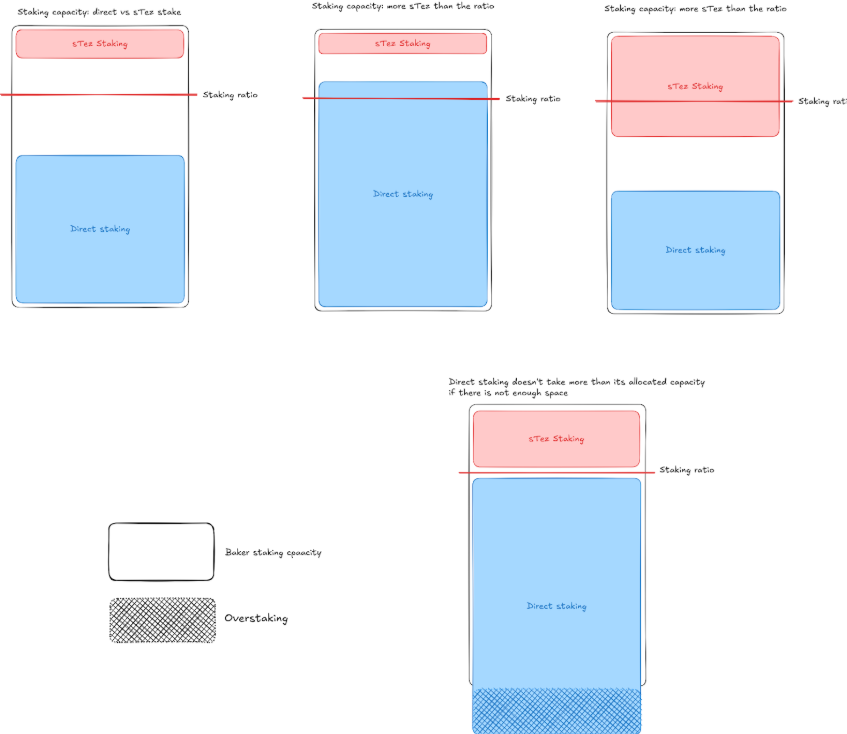
Bakers participate by registering with the enshrined liquid staking contract and setting two parameters:
- A ratio defining how much capacity they reserve for direct stakers versus enshrined liquid staking.
- A fee applied to rewards generated by enshrined liquid stake allocated to them.
Using the ratio, the protocol ensures that enshrined liquid stake doesn’t crowd out direct stakers if capacity is tight. Bakers can unregister or update parameters at any time.
Protocol rules and constants
New protocol constants govern the enshrined liquid staking mechanism and serve as guard rails. For example:
- Baker allocation maximum: The maximal share of stake capacity a baker can allocate to enshrined liquid staking
- Baker fee maximum: The maximal fee a baker can apply to rewards from the enshrined liquid stake allocated to them.
- Global allocation maximum: The maximal amount of XTZ that can be allocated to enshrined liquid staking.
- Eligibility criteria: In addition to registering their capacity and fee, bakers must have a clean slashing history over a specified period to receive stake allocations.
The intention with these constants is to make the system safe by default, ensuring healthy and fair distribution, but also adaptable through on-chain governance as real-world conditions change.
The types and values of protocol constants are work in progress. They are meant to be refined in cooperation with bakers and the wider community.
Timeline: U for testing, V for activation
The introduction of enshrined liquid staking would happen in two phases tied to two separate protocol proposals. The purpose is to carefully validate the mechanism and gather community feedback ahead of final activation.
- Protocol U: Included under a feature flag (in the code, but not active on Mainnet). An initial version of enshrined liquid staking will be available on a testnet, with the intention of refining the features and parameters with the wider community before activating on Mainnet.
- Protocol V: Potential activation on Mainnet. Following the testing and refinement phase launched with the U protocol, the feature is proposed for Mainnet activation in V.
If Protocol Proposal U is accepted through on-chain governance, detailed economics, parameters, and edge-case handling will be specified in an enshrined liquid staking whitepaper, allowing time for discussion and refinement before the V protocol proposal.